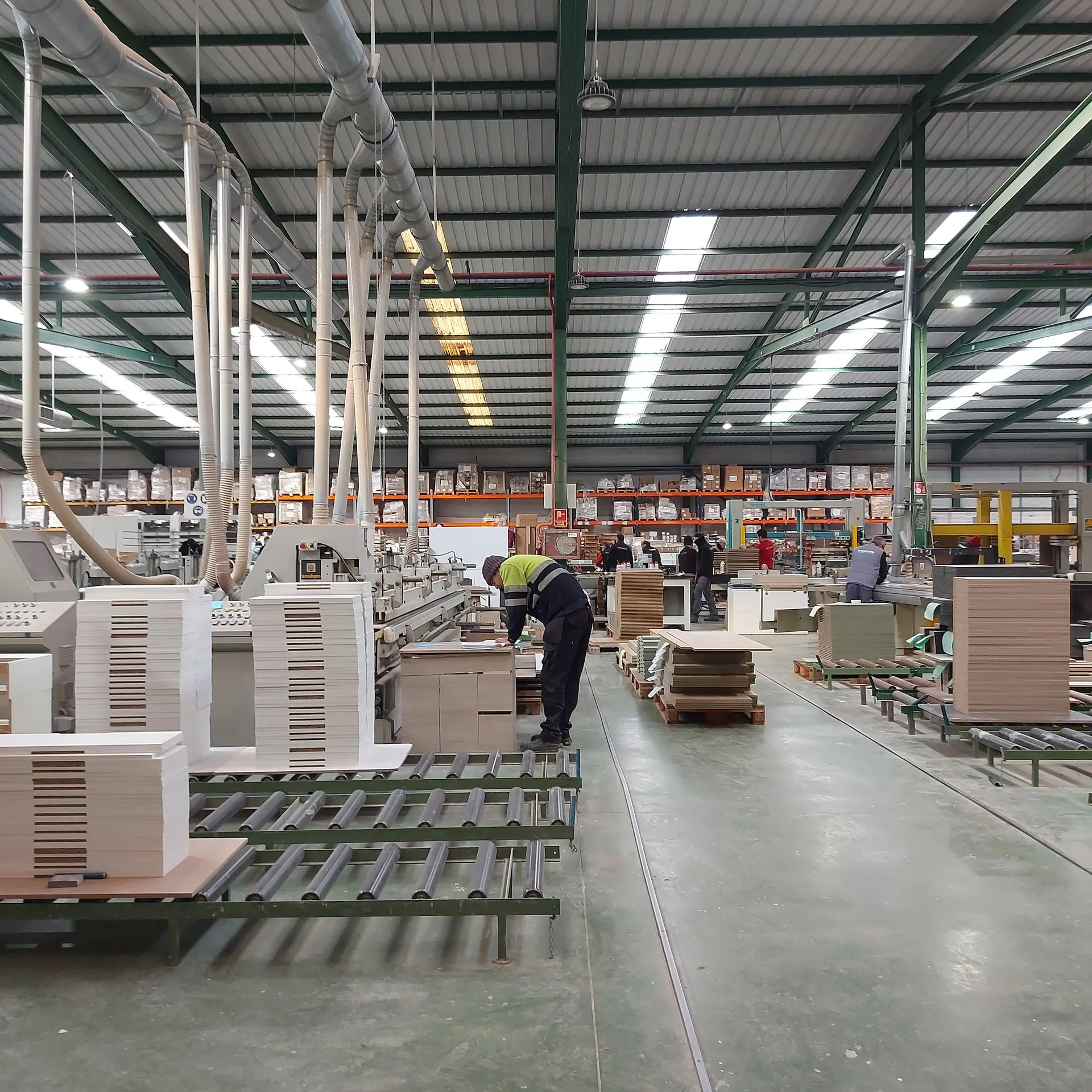
Design and Innovation
At Torbath Furniture, every manufacturing process begins with a strategic phase: design and innovation. This first step is key, as it marks the identity and functionality of each piece of bathroom furniture we develop.
Our design team works on creating proposals that combine aesthetics, ergonomics, and practicality, addressing both international trends and the real needs of users. Innovation is not limited to form or style: it also focuses on optimizing space, choosing moisture-resistant and sustainable materials, and incorporating technical solutions that facilitate daily use.
This stage lays the foundation for the entire process: it defines not only the appearance of each piece, but also how it improves the bathroom experience for the user.
100% In-House Production
At Torbath Furniture, after the design and innovation phase, we move on to a second fundamental stage: 100% integral production. This means that we internally control all stages of manufacturing, guaranteeing complete traceability and a final product that meets the highest quality standards.
We have three types of assembly that allow us to adapt to different volumes and needs:
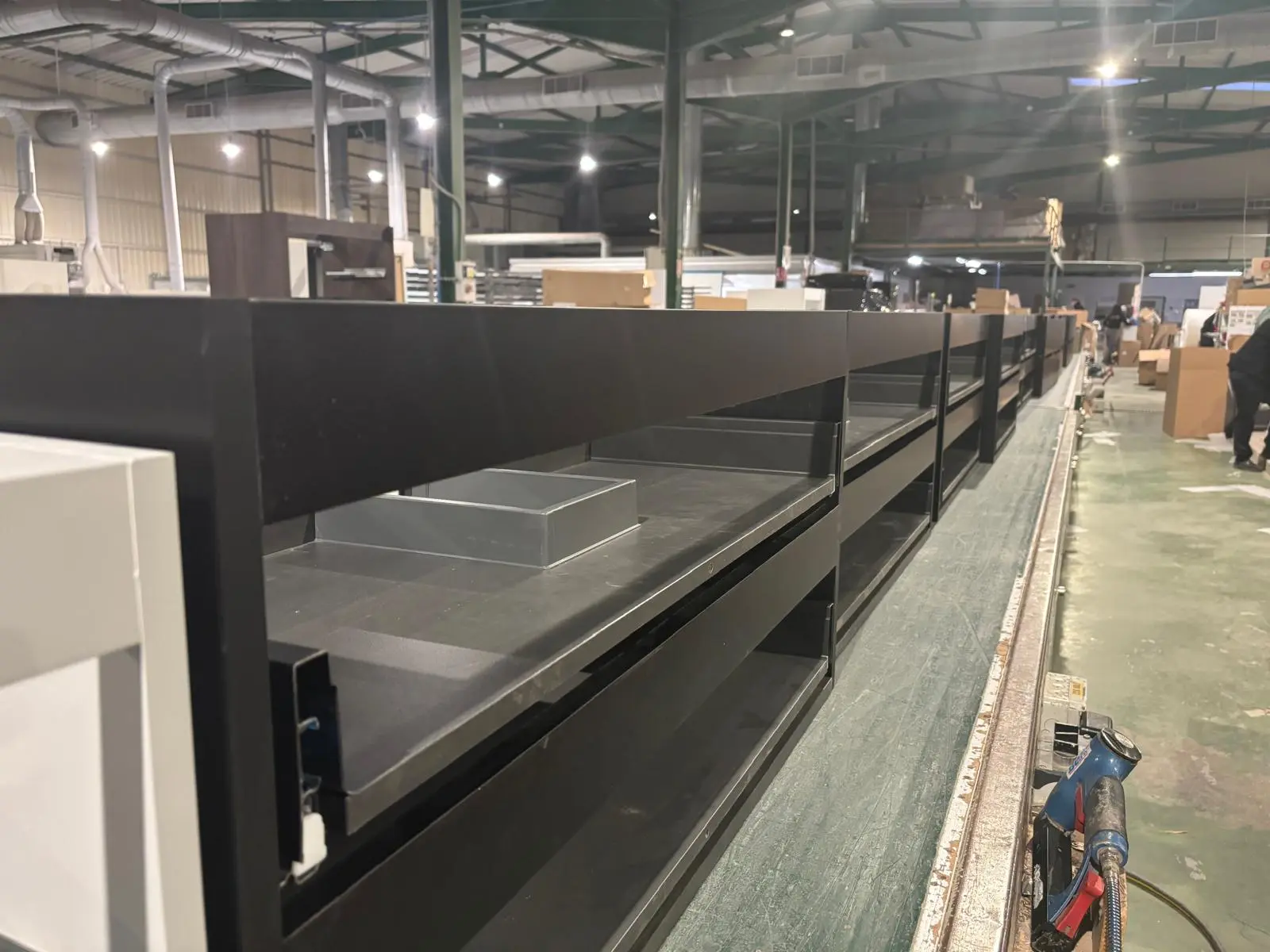
Assembled furniture and large production, designed to respond to high demands with maximum efficiency.
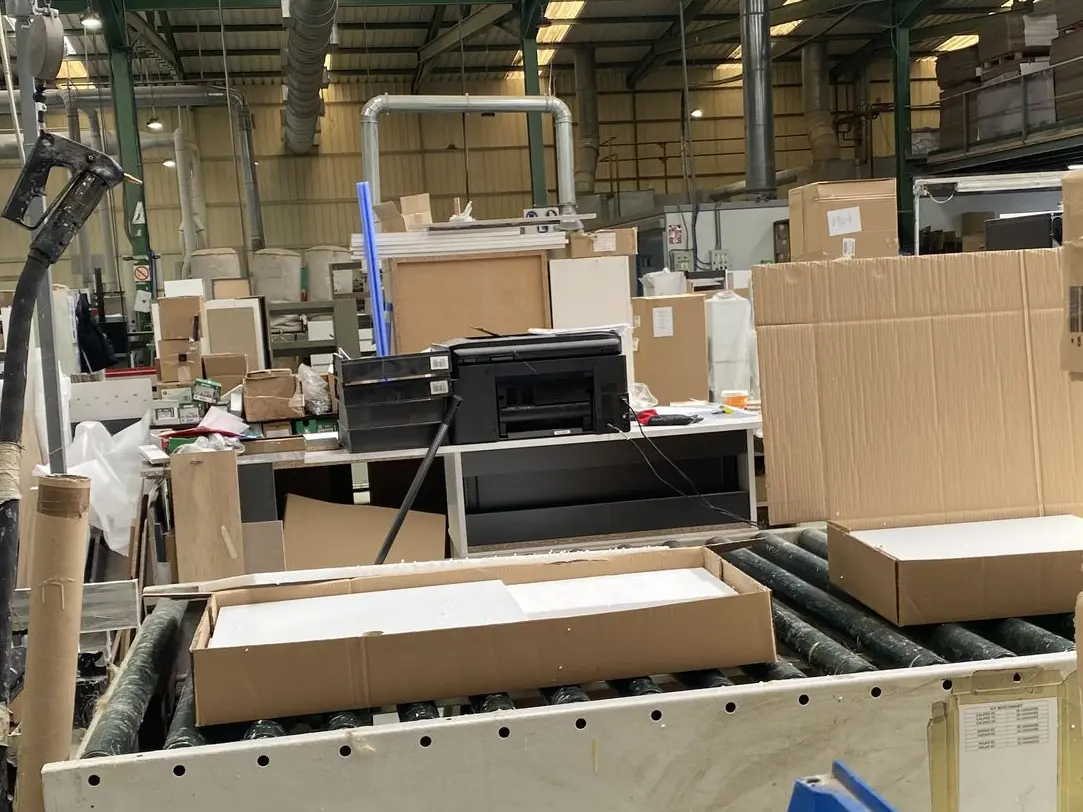
In kit form, with medium series around 300 units, offering a balance between industrial production and flexibility.
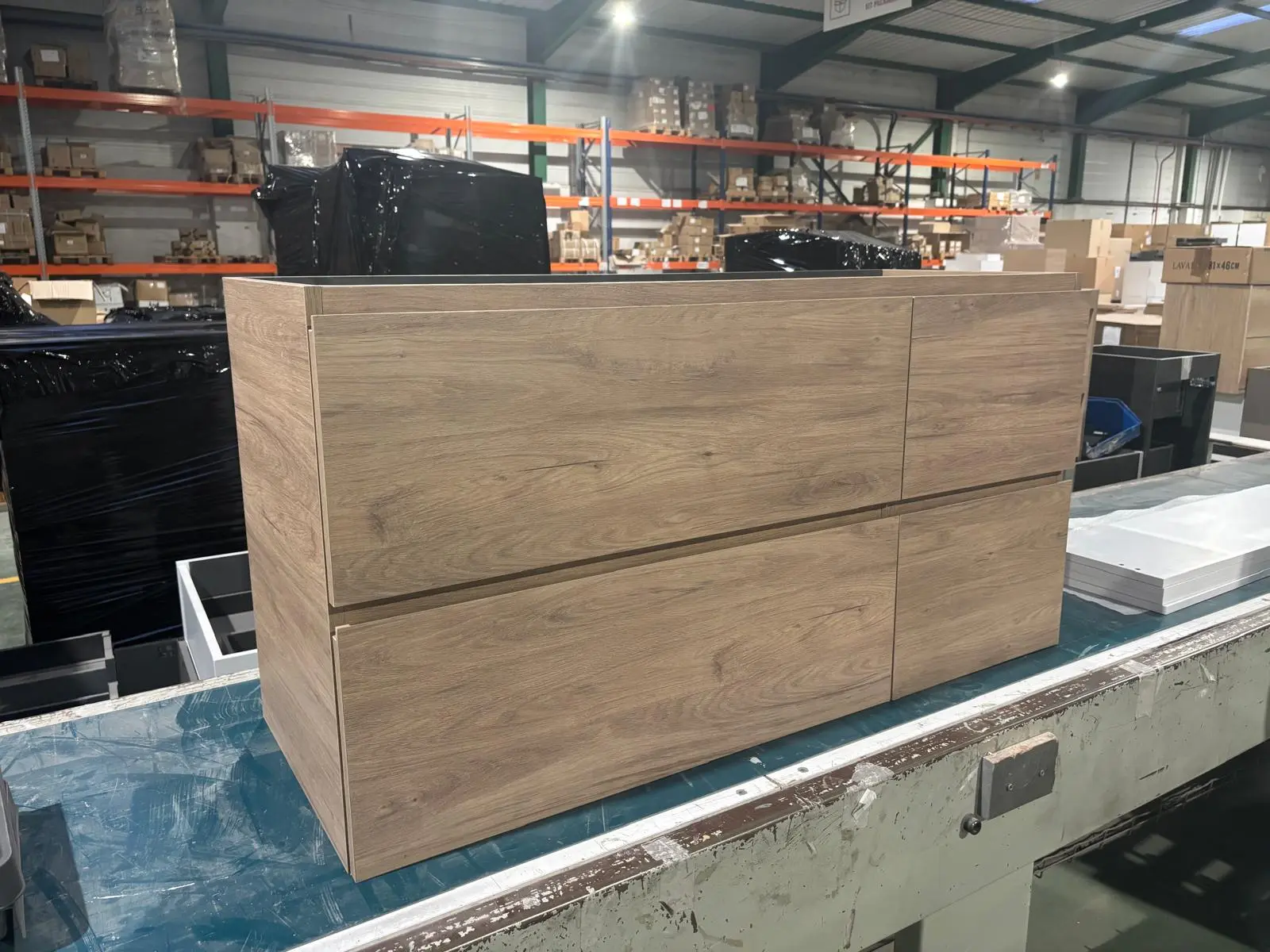
Made-to-order furniture, where our flexible machines work in low production to shape customized pieces and tailor-made projects.
The selection of raw materials is another pillar of this stage. At Torbath, we work with boards and components that are highly resistant to moisture, and we have FSC® certified materials when the customer requests it, reaffirming our commitment to sustainability and respect for the environment.
Thanks to this integral production model, we can offer a fully personalized service, ranging from mass production to the creation of unique pieces
Cutting machine
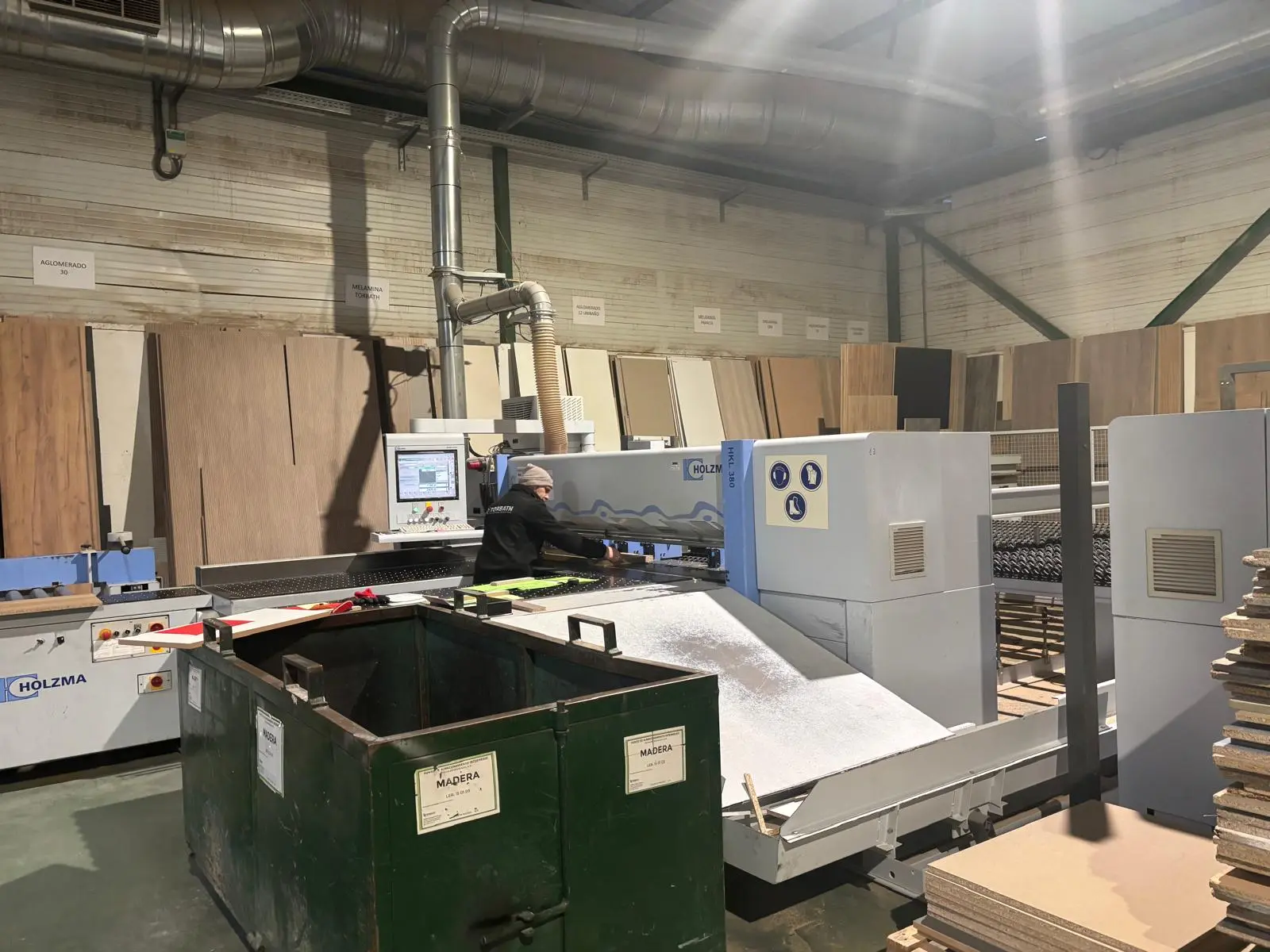
In the production of our bathroom furniture, the cutting machine plays a central role in the production process. It is the first material phase of the process, where raw material is transformed into the pieces that will shape each piece of furniture.
We work with large format boards, approximately 2.8 x 2.1 meters, which are precisely cut to obtain the different components of the furniture. Before each cut, an optimization program is generated, in which the exact measurements and required finishes are defined. This program is loaded into the machine, which automatically takes the boards and cuts them according to the specifications of the plan.
The operator plays a key role in this phase: he collects the cut pieces, identifies them with specific sheets according to their function (sides, fronts, etc.) and verifies that each one strictly meets the established dimensions.
This process ensures maximum utilization of the material, a millimetre precision in each piece and lays the necessary quality foundations for the subsequent assembly.
At Torbath Furniture, we understand the cutting machine as the tangible beginning of the life of each piece of furniture: where the board becomes a project.
Edging Machine
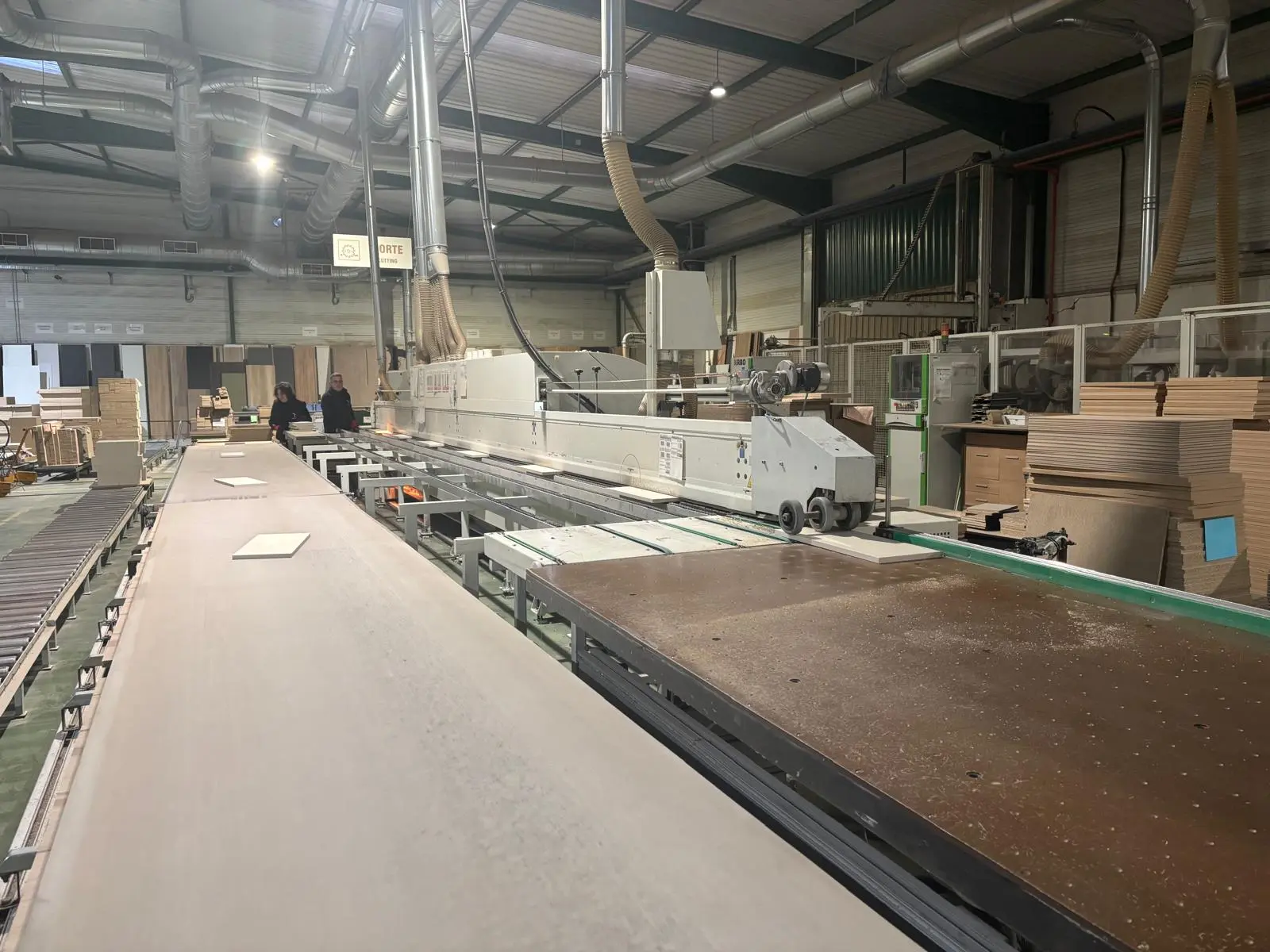
After the cut in the cutting machine, the pieces move to the edging machine, an essential stage to ensure both the strength and the final aesthetics of the furniture. Edging is the process by which the edges of each piece are covered and protected, ensuring durability against moisture and an impeccable visual finish.
At Torbath Furniture, we currently have three edging machines in operation, organized according to the type and size of the piece, as well as the number of edges to be edged:
Unilateral
Designed to work in a single pass over a single edge. It is ideal for smaller pieces or interiors that, due to their dimensions, cannot be processed in the double.
Double
Allows for edging two sides simultaneously in a single pass, and has an automatic loading and unloading system, optimizing time and ensuring high efficiency.
The result is a set of perfectly protected pieces, ready to continue with the subsequent phases of machining and assembly. At this stage, technology and organization combine to ensure that each Torbath furniture piece retains the quality and detail that characterizes it from its core to the smallest edge.
Machining
Subsequent to the edging process, the material moves to the machining section.
In this phase, the bars and bases of furniture are worked on in the spindle machines, where operators load the corresponding program to machine or machine and groove the pieces, as required by the design.
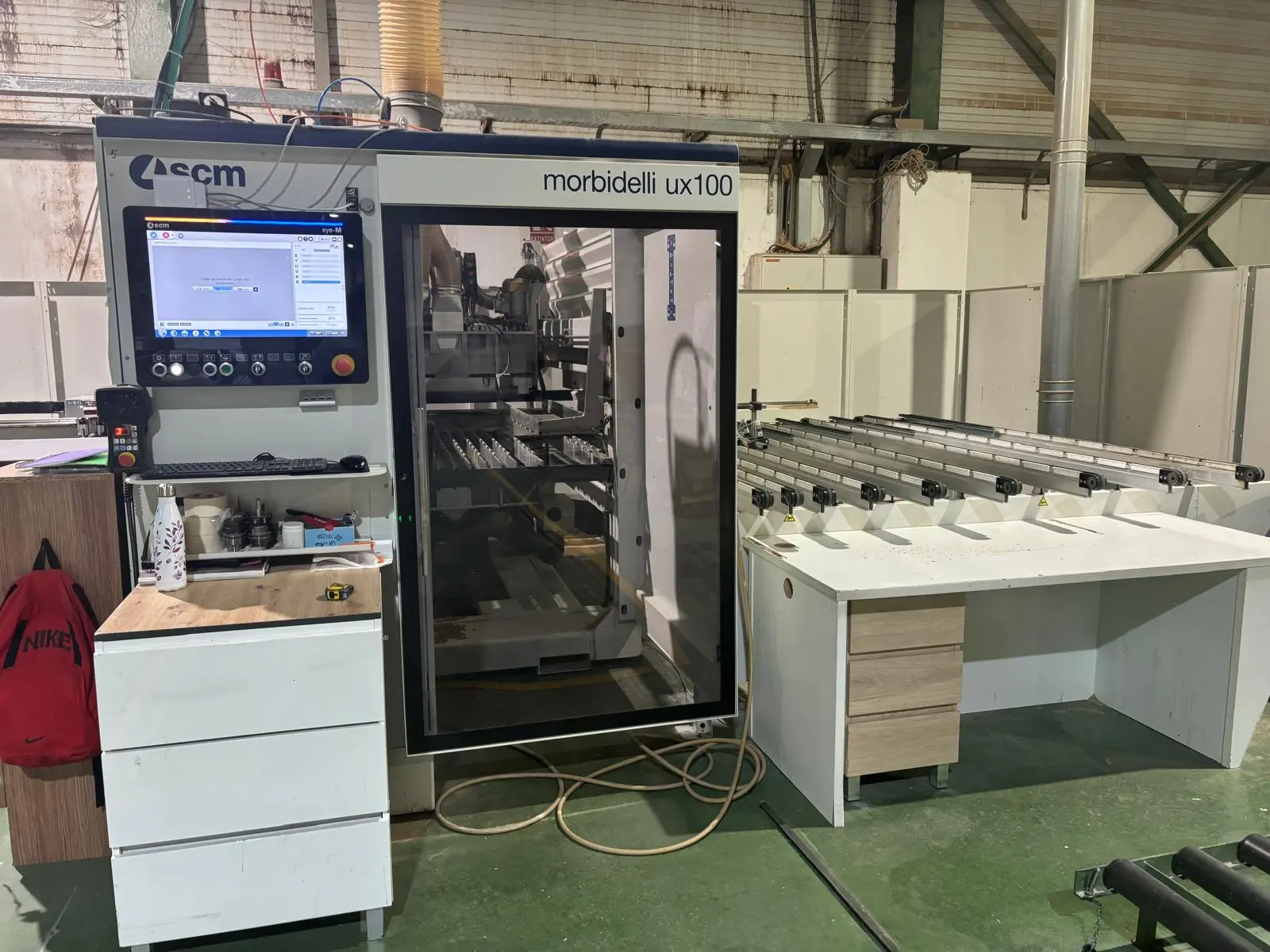
On their part, the sides and fronts (whether in melamine or lacquered) are machined on different equipment based on their characteristics and production volume:
UX 100
Usually used for fronts and sides in small or not very numerous series.
M 200
Used when the pieces require milling or in the case of working with MDF boards.
UX 200D
Indicated for large quantities of sides or fronts, as well as for pieces that only need grooving, such as furniture bases.
Regarding the interiors of drawers, especially those with siphon traps, they are machined on the M 200 or on the Morbidelli, as appropriate.
Once the material has been cut, edged, and machined, it moves to the next phase. In the case of lacquered furniture, particle boards (chipboard) are generally used. However, when the fronts have milling or finger pulls, these are made of MDF, while the rest of the furniture remains in particle board.
Varnishing line
The first step for lacquering, both on particle boards and raw MDF, is always sanding.
The edges and milling (if any) are sanded manually.
The surfaces are worked on a surface sander.
Once the pieces are sanded, the primer:
is applied to the edges by spray.
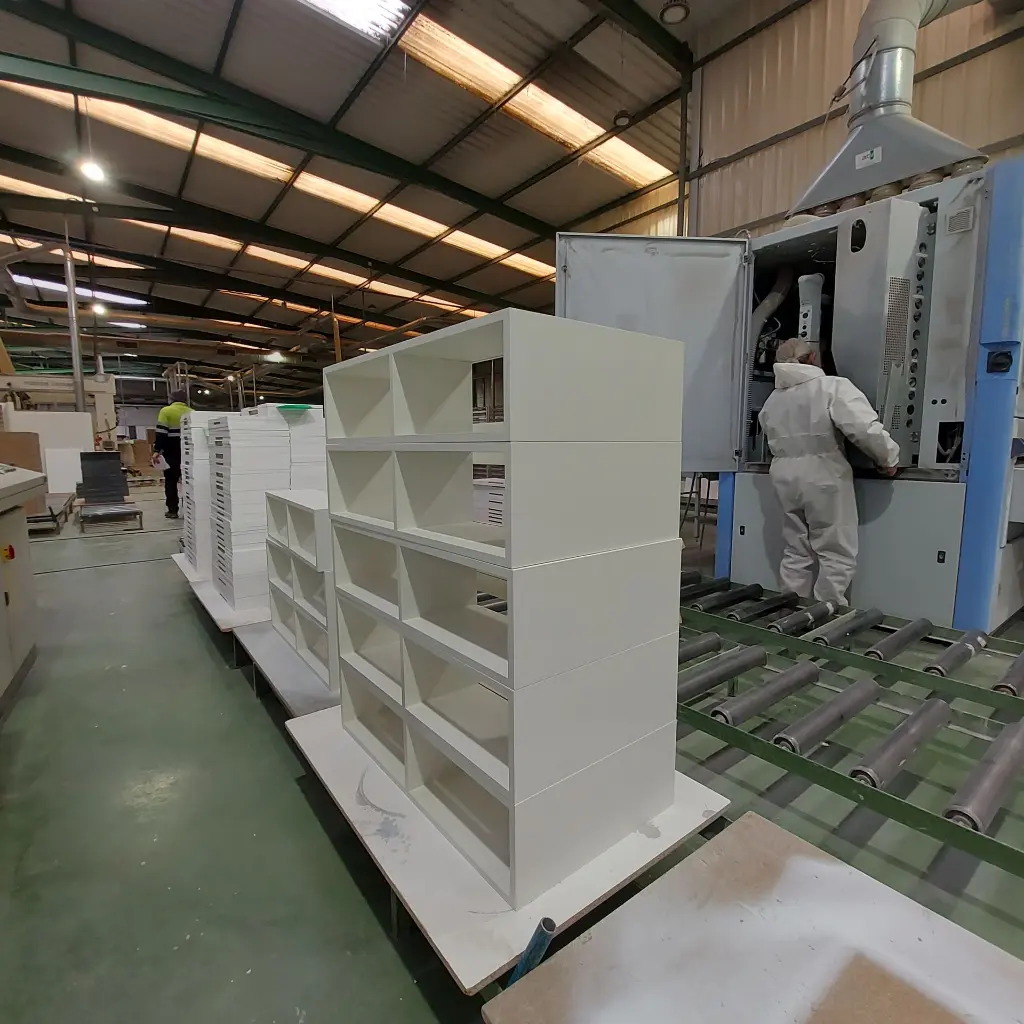
A package is prepared with the organized pieces, and only the sides are lacquered.
After drying, the surfaces are primed. For this process, we use a machine called the “background curtain,” which applies the necessary amount of material based on the type of piece.
Las piezas fondeadas se dejan secar unas 24 horas, para después volver a lijarse (cantos y uñeros a mano, y planos en la lijadora de superficies).
En este punto, la terminación varía según el tipo de acabado:
For the ultraviolet high gloss white, the pieces go through the Chefla, a machine that allows us to achieve the ideal finish directly, without the need for subsequent polishing thanks to parameter optimization.
For the colors or matte finishes, the lacquering is done with a spray gun in specific booths. These pieces require drying for between 12 and 24 hours, during which they are stored in dryers at a constant temperature.
Assembly
At this stage, all previously manufactured pieces are assembled to form the final piece of furniture.
The process combines manual labor and partial automation:
The initial assembly is done by hand by the workers.
Next, the pieces go through automatic pressing, the only fully mechanized process in this phase.
Subsequently, the drawers are placed, which have been previously assembled by a worker.
Upon reaching the packaging area, a worker bags the furniture, places the box, and operates the tipper with a pedal to complete the packaging.
Finally, the worker pushes the furniture along the conveyor to the palletizing area, not without first labeling it.
There are three differentiated lines:
Standard furniture assembled, following the described process.
Flat-pack furniture, in an independent line where boxes with all the pieces and hardware are prepared according to model, closed, and pallets ready for logistics are assembled.
Special furniture, which are manufactured and packaged on an independent line, piece by piece and completely manually.
Packaging
Packaging is the final phase of the production process and ensures that each piece of furniture arrives at its destination in perfect condition. To achieve this, we combine technology, protection, and traceability.
We have an automatic cardboard box manufacturing machine (Fandfol), which generates custom packaging in different widths, adapting to the dimensions of each piece of furniture. This way, we achieve a perfect fit, optimizing space and ensuring maximum protection.
The packaging process includes:
Edge and corner protections
They safeguard the most delicate areas.
Customized cardboard boxes
Made to measure by Fandfol.
Plastics and additional reinforcements
Protect against impacts, moisture, and dust.
Identifying labeling
Ensures complete traceability in the logistics chain.
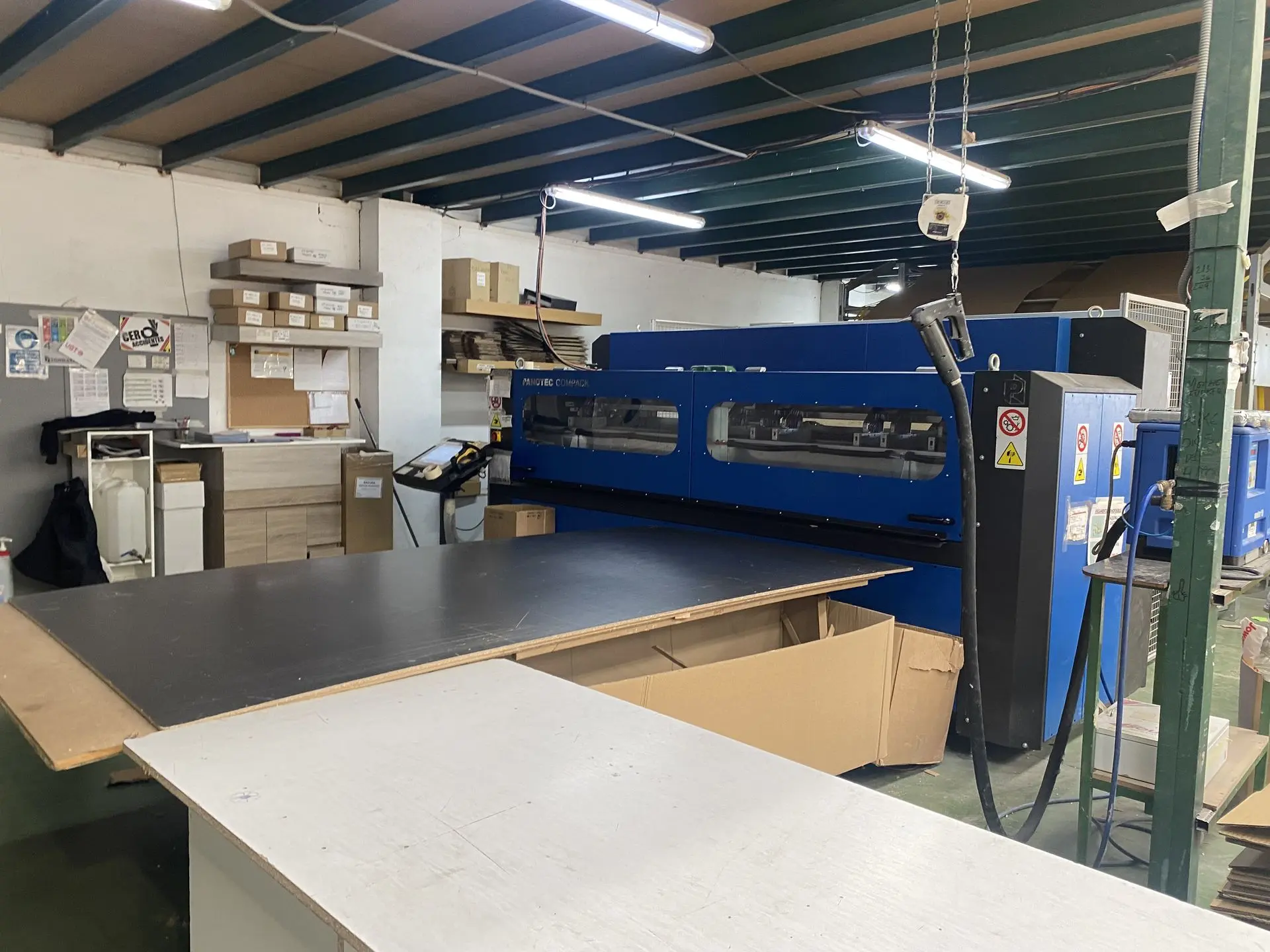
This system allows us not only to protect the integrity of the furniture but also to guarantee a professional and efficient presentation, in line with the quality standards that distinguish Torbath Furniture.
Quality control: Torbath guarantee in every detail
The quality control is a key phase in our production process, where it is validated that each piece and each piece of furniture meets the demanding standards of Torbath Furniture. It is not just a final review, but a comprehensive verification system that accompanies production at each of its stages.
In this phase, our specialized technicians meticulously examine:
Dimensions and finishes
Of each piece, ensuring that the measurements and edging match what is specified in the plan.
Material and assembly strength
Checking that they can withstand everyday use in a humid environment like the bathroom.
Aesthetic uniformity
Ensuring the continuity of color, shine, or texture throughout the series.
In addition, the furniture is inspected both individually and as a complete unit, ensuring that all components fit together perfectly before proceeding to packaging.
This step is the last safety barrier before a piece of furniture carries the Torbath seal: only those that successfully pass all checkpoints are approved to reach our customers. Thanks to this rigorous process, we ensure not only high-quality bathroom furniture but also the trust and peace of mind of those who choose them.